


I'm not actually going to talk much about the controversy of whether Library 2.0 has been debased or what such debasement might consist of. Except to note that I'm pretty blase about the fact that everything changes as a matter of course (this is in fact one of the things I think Library 2.0 is all about acknowledging) and slapping the "debasement" label onto a change makes it harder to see what good things are coming out of that change. As an example, it'd be hard for the Library 2.0 concept to be changed/'debased' if it weren't spreading quite a lot beyond its origins.
My blase-itude comes partly from a linguistics background which emphasises that just because a word changes its meaning or pronunciation doesn't mean the language as a whole is going downhill. It's just change, y'know. Which brings us to definitions. Simon Chamberlain says that "'we' don't have a clear definition of Library 2.0" and I get the impression that he thinks this is a unique and possibly bad thing.
But I'm not sure it is. After all, do "we" have a clear definition of the internet? Technical-minded people will talk about servers and networks and http protocols (and really technical-minded people will point out that the internet is far more than just http). People for whom this is so much gobbledegook might talk about Internet Explorer and Google. Other people might talk about online shopping and auctions. Others might talk about keeping uptodate with friends and family overseas, or about sharing hobbies on online forums(*), or internet dating. Others might stare at you blanking and gibber, because it's all of these things and a whole lot more besides, and how do you sit down and define all that?
Same thing with Library 2.0. It's about technology, and it's about people; and it's about a paradigm shift, and it's doing what we've always done but better; and it's about the cool factor, and it's about making things tie together seamlessly so no-one even notices you've done anything.
That's not a clear definition. But what is? We live in a complicated world; why should we expect the language we use to describe that world to be any simpler?
(*) Did I mention that language change isn't devolution? If I were writing this post in Latin I'd say "fora" - or "foris" or however it'd be declined there - but if I were writing this post in Latin it'd be a lot shorter.
Wednesday, 30 January 2008
Wednesday, 23 January 2008
Search engine wishlist
Blogging about technology for 23 Things...
I recently read somewhere or other about Wikia search which... is a work in process obviously and thankfully.
But it reminded me of how I'd ranted to a colleague the other day that it's only the complete and utter lack of any programming skills whatsoever (well, Basic and html and a tiny bit of javascript) that stops me creating my own search engine which would search on synonyms automatically: so someone could type in "television" and the search engine would search for "television OR TV OR telly". Then it'd rank the results so that results with more of the synonyms were rated higher. And it'd also know when one word can have two meanings and figure out which meaning was intended according to what other keywords were used, or - if no other keywords are available to disambiguate - can ask the user which meaning was intended.
Okay, it has potential for all sorts of havoc and it'd probably be a bit tricky, but (as a non-programmer) I don't think it'd be *too* tricky; is there really no-one working on something like this?
I recently read somewhere or other about Wikia search which... is a work in process obviously and thankfully.
But it reminded me of how I'd ranted to a colleague the other day that it's only the complete and utter lack of any programming skills whatsoever (well, Basic and html and a tiny bit of javascript) that stops me creating my own search engine which would search on synonyms automatically: so someone could type in "television" and the search engine would search for "television OR TV OR telly". Then it'd rank the results so that results with more of the synonyms were rated higher. And it'd also know when one word can have two meanings and figure out which meaning was intended according to what other keywords were used, or - if no other keywords are available to disambiguate - can ask the user which meaning was intended.
Okay, it has potential for all sorts of havoc and it'd probably be a bit tricky, but (as a non-programmer) I don't think it'd be *too* tricky; is there really no-one working on something like this?


Thursday, 17 January 2008
Other duties as required
I was going to write this post last year; it was going to be very witty and all. But then Christmas came up and now I've forgotten all the scintillating sentences I'd composed while working with two of my colleagues to move several stacks' worth of books en masse one stack to the right. The "other duties as required" part came into it because we had the cleaners' vacuum cleaner out and as the books moved from one stack to the next, the tops of them got vacuumed on the way; this amused me.
The reason I'm writing the post now is that we've just done the same thing again, with another three stacks of books and Bible-weight journals covered in dust thick enough to grow potatoes in. (We didn't vacuum this time due to time pressures.) It's the sort of process that looks incredibly daunting to start with, and 30+ Celsius temperatures don't help, but what does help is:
The reason I'm writing the post now is that we've just done the same thing again, with another three stacks of books and Bible-weight journals covered in dust thick enough to grow potatoes in. (We didn't vacuum this time due to time pressures.) It's the sort of process that looks incredibly daunting to start with, and 30+ Celsius temperatures don't help, but what does help is:
- teamwork. Everything's more fun when you've got a colleague around to mock for breaking a shelf. (That shelf was trouble, and I got mocked in turn for breaking it myself.)
- music. Last year we played the Beatles, this year a mixture of opera and some more modern stuff which the heat has caused me to forget, although a scary rock version of "O Come All Ye Faithful" is niggling at my mind. Music really helps, especially when one of your colleagues can be relied on to entertain us with his dance moves.
- a break halfway through. Tea/coffee/water, chili chocolate, plums/crackers, and zoning out.
- paper darts. Thoughtfully left for us in the stacks by years of engineering students.
- workflow. Last year's effort involved condensing the shelves as we went so one person loaded a booktrolley at one end, another vacuumed, and another unloaded it at the other end. This year we were just moving things straight across, so we worked in pairs, passing books through stack A to the librarian putting them on the same shelf on stack B.
- soap. For the hands that inevitably turned black.
- sorbets. Brought in for us when we'd completed by our thoughtful manager. Callippo All-fruit (or something like that; here endeth the product placement) mango flavoured; mmm!
Tuesday, 8 January 2008
Online flowchart generator
Last year a new course started here, compulsory for all 700-odd intermediate-year engineers at the university. On the plus side, the course coordinator was wonderful about getting the library involved in their first assignment; on the minus side... well, 700 intermediate-year engineers all desperately needing to know how to cite websites and videos in APA.
So this year I'm creating an ambitious display all about citing. It's going to have whats, whys and hows; a three-step process; links to more online information; possibly a puzzle with prizes (must ransack the drawer of vendors' highlighters to see if we've got anything fun); and a tip of the day with "ingredients", a flowchart, and "here's some we prepared earlier" examples.
So I needed to make flowcharts. I wasn't going to draw them by hand or mess about with Word shapes. I remembered playing with an online flowchart generator which was awkward but workable - I just couldn't remember the name or find it again. This was lucky, because instead I found Gliffy
Gliffy's free demo lets you have five free flowcharts - that means five at any one time, as you can create a chart, save it as a jpg (or png or svg), 'revise' it into a completely new chart, rinse and repeat as many times as you like (or at least as many times as I've needed - 14 so far).
It's all click-and-drag, very user friendly. Far more options than I need or understand, but easy to find the options I do need. Colours, fonts, sizes and styles are customisable. Arrows attach to boxes so things can be dragged about and stay attached to each other. Copy and paste works!
An example of one of the flowcharts I've been making, for how to cite journal articles in APA:

So this year I'm creating an ambitious display all about citing. It's going to have whats, whys and hows; a three-step process; links to more online information; possibly a puzzle with prizes (must ransack the drawer of vendors' highlighters to see if we've got anything fun); and a tip of the day with "ingredients", a flowchart, and "here's some we prepared earlier" examples.
So I needed to make flowcharts. I wasn't going to draw them by hand or mess about with Word shapes. I remembered playing with an online flowchart generator which was awkward but workable - I just couldn't remember the name or find it again. This was lucky, because instead I found Gliffy
Gliffy's free demo lets you have five free flowcharts - that means five at any one time, as you can create a chart, save it as a jpg (or png or svg), 'revise' it into a completely new chart, rinse and repeat as many times as you like (or at least as many times as I've needed - 14 so far).
It's all click-and-drag, very user friendly. Far more options than I need or understand, but easy to find the options I do need. Colours, fonts, sizes and styles are customisable. Arrows attach to boxes so things can be dragged about and stay attached to each other. Copy and paste works!
An example of one of the flowcharts I've been making, for how to cite journal articles in APA:

Friday, 14 December 2007
More fun with weeding
Things found today:
- a bunch of 1992 press releases from a company I've never heard of;
- a government guide to decimal currency for businesses, prepared when NZ changed from pounds and shillings in 1967 - very cute and absolutely fascinating, but we've got copies in other branches where it's more likely to be used. I read it cover to cover before respectfully disposing of it;
- a pair of books which perfectly fit our criteria to be disposed of (another copy in another branch; not quite in our subject area; have had practically no use) - but they were so lovely we couldn't bring ourselves to do it and they're now back on the shelves;
- moths. As I pulled down several bundles of journals (tied together with binding tape a decade or so ago and clearly never touched since) a couple of moths flew out at me. I wasn't fast enough to dispose of them along with their erstwhile home, but with luck the tidier shelves will prove an environment too hostile for them to breed in.
Tuesday, 11 December 2007
What, will these hands ne'er be clean?
Our library is soon to be getting a new and much-needed lift, to make room for which we are undertaking a large collection management exercise (aka "weeding", though I personally prefer the "pruning" metaphor - getting rid of both deadwood and of nice enough shoots in order to make the collection as a whole bear more fruit) in part of our collection.
While studying for my MLIS, in a temporary fit of determination to actually study, I came up with a mnemonic for twelve ways pruning could benefit a collection. I can't remember it anymore, but I'm still a great fan of the process, so this post title doesn't refer to any kind of guilt, but rather much more prosaically to the fact that, while we're working our way through this, for approximately 7.5 hours of each day my hands are grey with decades-old dust.
My favourite candidate for deaccessioning so far is Objections to removal of Fendalton shops: shops proposal in doubt (this link may not work for very long...). It was a slim A5-sized thing, the kind of quarter-flushing-type work our bindery used to do decades ago. I opened it up to find the barcode and discovered it wasn't a bound report; it was a pocket. A pocket containing two newspaper clippings. From 1966.
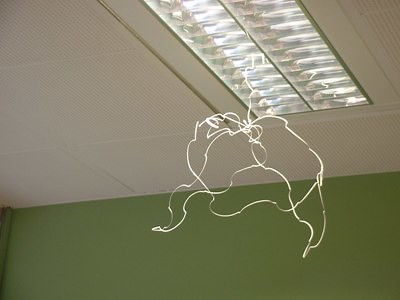
It's now being recycled. The relatively nice books (duplicates and such) we put out for students to browse through, but the really ridiculously thick-with-dust what-were-we-thinking? ones we put in the recycling bin; we're green that way. We've also been dismantling plastic ringbinders to extract the cardboard inside for recycling, and tearing apart spiral-bound reports to recycle the paper and throw out the wire/plastic. Today (possibly a little bored by now of wielding the "cancelled" stamp) I used some spiral-binding wire to make a bracelet for my sister (Merry Christmas!); and my colleague, inspired by the artistic possibilities in the length of wire I tore from another ancient report, made the sculpture you see above, which she's kindly allowed me to name "Lampshade".
Tuesday, 4 December 2007
More fun things to do with Skype
We've been having a look at possible new designs for our library website and today we've been running usability testing on two favourites. What we do is have the tester in one room with a facilitator beside them, a note-taker behind them, and next door a group of observers watching a) a view of the computer screen and b) a closed-circuit video of the tester. (The note-taker is in the room in case the video link breaks. Testers are told other observers are watching but that we're not recording.)
Normally for the closed-circuit link we use video equipment booked and carted over from the AV department, but today when I arrived to do my duty as an observer I discovered they'd set it up using Skype instead. It worked well: there were problems with sound volume (a function of the hardware: we used our regular webcam, but a clip-on microphone for the tester would probably be better), but quality otherwise was just fine.
(The usability testing was, as usual, fascinating. Although it covered the library website as a whole, there were several points where testers were using the library catalogue (of which, I was recently part of a project group to find and fix as many things as we could fix for free in a short timeframe), and one question asked was if they'd noticed any of the multitudinous changes. Yes: they noticed the new colour scheme. On the plus side, they approve.)
Normally for the closed-circuit link we use video equipment booked and carted over from the AV department, but today when I arrived to do my duty as an observer I discovered they'd set it up using Skype instead. It worked well: there were problems with sound volume (a function of the hardware: we used our regular webcam, but a clip-on microphone for the tester would probably be better), but quality otherwise was just fine.
(The usability testing was, as usual, fascinating. Although it covered the library website as a whole, there were several points where testers were using the library catalogue (of which, I was recently part of a project group to find and fix as many things as we could fix for free in a short timeframe), and one question asked was if they'd noticed any of the multitudinous changes. Yes: they noticed the new colour scheme. On the plus side, they approve.)
Subscribe to:
Comments (Atom)